


Flower Gallery:
|
Flowers are, by design, seducers. They exist to perpetuate their own species. Blossoms are their reproductive structures. Anchored to the plant, a flower cannot go off in search of a pollinator. Instead, it must attract the attention of a pollinator and entice it to make contact. The bold physicality of a flower – its sculptural form, its unique color palette, its delicious scent – is something we often appreciate from a distance. Only rarely do we thrust our nose right into a flower to sniff and stare. I first began shooting flowers casually, several years ago, in an attempt to hone my camera skills. I chose flowers because they were readily available – and static. It didn't take long before I found myself totally engaged by my subjects. I brought my camera closer and closer to the flowers, wishing I could experience their "monumentality" much as an insect might. 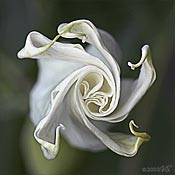 When
I select a flower to shoot, I don't pay much attention to its color. Its
sculptural form
is my primary consideration, along with the quality of light and how it
interacts with the bloom. Color often doesn't enter into it at all. I usually
shoot outdoors using available
light. Once in awhile, if it is breezy, I will bring a flower inside
and place it by a window. I do not use studio lights. When
I select a flower to shoot, I don't pay much attention to its color. Its
sculptural form
is my primary consideration, along with the quality of light and how it
interacts with the bloom. Color often doesn't enter into it at all. I usually
shoot outdoors using available
light. Once in awhile, if it is breezy, I will bring a flower inside
and place it by a window. I do not use studio lights.My current equipment is pretty basic. I have a Canon EOS 5D (12.8 megapixel digital SLR camera), six lenses (including the Canon EF 100MM F/2.8 Macro and Canon EF 70-200 F/2.8 IS EF), a set of diopters, an extension tube, some filters, and a good strong tripod. Unless I am shooting a subject for a decidedly square format, I avoid cropping my photographs. I strive to compose my subject in the viewfinder exactly as I want it to appear in print. I use Adobe Photoshop CS2 running on a G5 Macintosh computer to make minor adjustments to my photographs, usually cleaning up a blemish here and there, adjusting an exposure, or balancing the tonal range. While I love using Photoshop to manipulate and transform photographic images, when it comes to botanicals, I use Photoshop very sparingly. I am not interested in creating illustrations of flowers. Instead, I present them as I "saw" them (with the aid of my camera) in space and time. – Virginia
Saunders
March, 2006
|

Photography & Graphics ©2003-2006 Virginia Saunders All
rights reserved
Virginia Saunders, PO Box 50314, Columbia, SC 29250, 803-783-3169
ginnie@florigraphy.com
Domains: Florigraphy.com & FlowerPhotographer.com